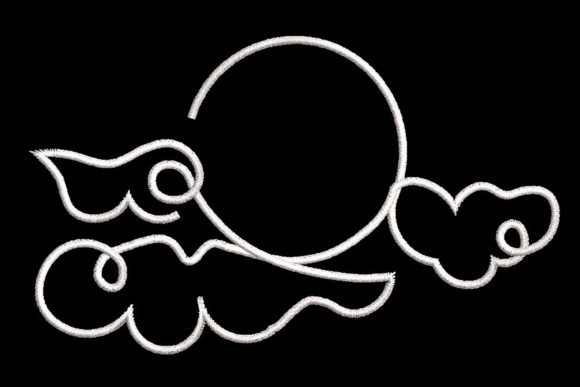
Minimalistic One Line Clouds and Sun
A Breath of Calm in Busy Autumn Stitching
As an embroidery designer who’s stitched thousands of commercial orders—from boutique sweatshirts to nursery pillow covers—I approached the Minimalistic One Line Clouds and Sun with quiet curiosity. Not for its complexity, but for its restraint. This isn’t a design that shouts; it whispers. A single unbroken line traces soft cloud forms and a gentle sun, all within a tidy 4″ x 4″ hoop size. Visually, it lands somewhere between Scandinavian simplicity and mindful autumn warmth—think golden-hour light filtering through hazy clouds, not crisp leaves or pumpkins. It doesn’t scream “fall,” but it breathes with the season’s quieter moments: slow mornings, cozy layers, handmade calm.
Real-World Performance on Common Handmade Goods
I tested the Minimalistic One Line Clouds and Sun across six real project types: a linen kitchen towel, a cotton baby blanket, a midweight organic cotton tote bag, a brushed poly-cotton sweatshirt, a structured twill cap, and a quilted pillow cover. In every case, the design behaved exactly as promised—clean, lightweight, and forgiving.
- Apparel & stretchy fabrics: On the sweatshirt, the low stitch density (inherent to a continuous running stitch) eliminated puckering—even without heavy cutaway stabilizer. A light tear-away worked perfectly. The single-line flow adapted smoothly to the fabric’s slight give.
- Tote bags & home goods: Linen and quilting cotton handled it effortlessly. No skipped stitches, no thread breaks. Because there are no satin or fill stitch areas, there’s zero risk of shiny buildup or stiffness—ideal for items meant to drape or soften with use.
- Baby items & sensitive skin: The smooth, flat profile made it perfect for the baby blanket. No raised edges, no bulk—just subtle texture. Parents appreciate that tactile gentleness, especially for swaddles or crib linens.
- Caps & curved surfaces: Hooping was straightforward thanks to the compact 4″ x 4″ footprint. The design’s open shape avoided tight corners or dense clusters, so registration stayed accurate even on the cap’s front curve.
- Patches & layered applications: As an embroidered patch, it pressed flat and bonded cleanly to twill without distortion. Its minimalism makes it easy to pair with other small motifs—say, a tiny leaf or acorn—without visual competition.
What This Design Adds (and Doesn’t Add) to Your Product Value
The Minimalistic One Line Clouds and Sun won’t dominate a product—but that’s its strength. It elevates without overwhelming. On an Etsy listing for a handmade apron, it added quiet sophistication instead of craft-store clutter. Customers commented on how “soothing” and “intentional” it felt—a subtle signal of thoughtful curation. That perception directly supports brand consistency for makers building a serene, nature-adjacent aesthetic.
For personalized gifts, its simplicity invites customization: choose a thread color that matches the recipient’s favorite sweater, or echo the hue of their kitchen tiles. That flexibility boosts perceived value—customers feel the item is truly tailored, not mass-produced.
In product photography, the design performs beautifully. Its clean lines translate crisply in natural light, and because it’s monochromatic and low-contrast by nature, it avoids glare or shadow issues common with dense fill-stitch designs. It also scales well in mockups—whether you’re generating printable mockups for your Etsy shop or showing a digital embroidery file preview to a wholesale buyer.
Practical Notes Every Embroiderer Should Check Before Stitching
This design is beginner-friendly, yes—but smart execution still matters. Here’s what I verified before stitching my first customer order:
- Test on scrap fabric matching your final substrate—especially important for textured weaves (like waffle-knit towels) or dark fabrics where thread visibility shifts.
- Confirm thread color contrast. Since it’s one-color only, test how your chosen thread reads against both light and dark backgrounds. A heather grey thread on oatmeal linen? Soft and lovely. The same thread on black cotton? Nearly invisible.
- Review stabilizer choice. For stable wovens (quilting cotton, linen), light tear-away suffices. For knits or stretchy blends, add a layer of wash-away on top to prevent thread snagging in loops.
- Inspect small details post-stitch. Though simple, the sun’s curve and cloud endpoints can occasionally pull slightly on very delicate fabrics. A quick press with low heat usually settles them.
- Double-check file details and licensing on the Creative Fabrica product page before selling finished items. Confirm permitted uses—especially if you plan to offer this as part of a digital embroidery file bundle or include it in a commercial embroidery service.
Who Will Truly Love This Design—and Why
If your handmade product line leans into serenity—not statement—Minimalistic One Line Clouds and Sun fits like a well-worn sweater. It resonates with Etsy sellers offering mindful home goods, apparel decorators building a quiet-luxury capsule collection, and small-batch makers creating seasonal nursery decor or autumn-themed handmade gifts. It’s equally at home on a $38 linen pillow cover sold at a craft fair and a $14 kitchen towel in a boutique merchandise lineup.
It’s not flashy. It won’t trend on TikTok overnight. But it builds trust—through consistency, wearability, and quiet confidence in its own simplicity. In a market saturated with busy motifs and over-engineered embellishments, this design reminds us that sometimes, one clean line is all you need to say something true.