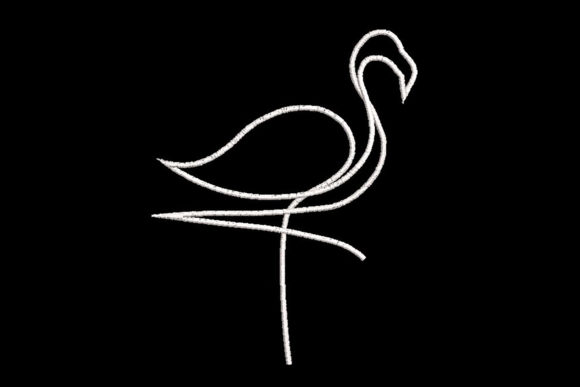
Minimalistic One Line Flamingo
A Clean, Confident Silhouette—Not Just Another Bird Design
When I first opened the Minimalistic One Line Flamingo embroidery file, I didn’t see a bird—I saw rhythm. A single, unbroken line curls into that unmistakable S-curve: neck arcing down, leg stretching out, beak tipping just so. It’s not illustrative; it’s evocative. That matters more than you’d think when you’re stitching for real customers—not Pinterest pins, but people buying a handmade tote bag at a local market or ordering a personalized baby onesie as a shower gift.
What It Actually Looks Like Stitched—Not Just on Screen
I tested Minimalistic One Line Flamingo on a medium-weight cotton canvas tote—no lining, no interfacing, just clean natural fabric and tear-away stabilizer. The result? Crisp, confident, and surprisingly bold at 4″ x 4″. Because it’s a continuous running stitch (not satin or fill), there’s zero bulk—no puffing, no shadowing, no thread nests. On a soft heather grey sweatshirt? Equally clean, especially with a contrasting thread like coral or charcoal grey. But here’s what stood out: the design breathes. It doesn’t compete with fabric texture—it works *with* it. That makes it ideal for apparel where subtlety reads as sophistication, not compromise.
Where It Shines—and Where It Needs Thought
Minimalistic One Line Flamingo excels in projects where less is legible, memorable, and commercially smart:
- Tote bags and tea towels: Its open shape leaves room for fabric to show through—perfect for artisanal branding or boutique merchandise.
- Baby items and nursery decor: No dense fills means no stiffness—ideal for delicate cotton onesies or muslin pillow covers.
- Patches and caps: At 4″ x 4″ hoop size, it fits standard hoops without scaling down. On curved surfaces like baseball caps, I recommend light cutaway stabilizer and slowing the machine speed by 15% to keep the line smooth through the curve.
- Holiday or wedding gifts: Paired with neutral thread on ivory linen napkins or blush pink terrycloth towels, it reads elegant—not cutesy.
But be mindful: this isn’t a design for ultra-thin fabrics like silk charmeuse without backing, or highly stretchy knits without proper stabilization. On dark fabric, test your thread contrast first—light thread can vanish on deep navy unless you use a matte polyester with high sheen control. And avoid placing it near seams or darts on fitted garments; the single-line flow needs clean, flat real estate to land right.
How It Shapes Perception—Of Your Product, Your Brand, Your Craft
Customers don’t buy “a flamingo.” They buy intention. When someone sees Minimalistic One Line Flamingo on a hand-stitched apron at a craft fair, they read craftsmanship—not clutter. That visual clarity builds trust: it says you edit thoughtfully, you understand balance, you value restraint. For Etsy sellers, that translates directly to higher perceived value—even if the stitch count is low. Buyers associate clean lines with quality execution, not low effort. And for small shop owners building cohesive collections (think coastal kitchen bundles or modern nursery sets), this design slots in effortlessly—no rebranding needed.
Real Designer Notes—Before You Stitch or Sell
This isn’t theoretical. Here’s what I did—and what I’d tell any fellow designer or creative entrepreneur before using Minimalistic One Line Flamingo:
- Test on scrap fabric first—especially if you’re using textured weaves, terry cloth, or lightweight knits. Running stitch behaves differently across surfaces.
- Check thread color contrast in natural light, not just under your machine lamp. Coral thread pops on oatmeal linen but disappears on rust-toned canvas.
- Review stitch density in your embroidery software. Even minimal designs can have tight corners that snag on low-end machines—zoom in on the beak and foot junction.
- Confirm hoop size compatibility. While labeled 4″ x 4″, some files include tiny margin buffers. Measure the actual design bounding box before hooping.
- Mock it up in black and white—yes, really. If the silhouette holds up without color, it’ll hold up on any fabric background.
- Use appropriate stabilizer: tear-away for stable wovens, cutaway for knits, and lightweight fusible for lightweight linens.
- Verify licensing terms before listing finished products or digital embroidery files for resale. Not all “minimal” designs are cleared for commercial embroidery or digital redistribution.
Final Thought: It’s Not About the Flamingo—It’s About the Feeling
The Minimalistic One Line Flamingo doesn’t shout. It leans in. That makes it unusually versatile—not because it fits every project, but because it elevates the ones it *does* belong to. Whether you’re embroidering a custom sweatshirt for a boutique launch, stitching holiday gifts for loyal clients, or building a signature collection of printable mockups for your digital shop, this design earns its space. It’s quiet confidence, stitched in thread. And in today’s oversaturated handmade market? That kind of clarity isn’t minimal—it’s essential.