French Horn Lineart: A Designer’s Real-World Review
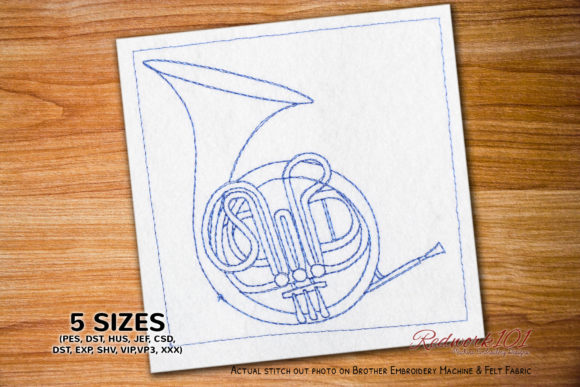
As a designer who’s stitched hundreds of music-themed embroidery files for boutique apparel, nursery decor, and custom gift lines, I opened French Horn Lineart expecting clean minimalism—and found something more valuable: quiet confidence. This isn’t a flashy, ornate instrument illustration. It’s a single-line contour that traces the elegant coil and flared bell with surgical precision—like a musician’s quick sketch before rehearsal. That restraint is its strength.
First Impressions: Where Simplicity Meets Story
The lineart feels both academic and affectionate—like it belongs on a music teacher’s apron or a conservatory grad’s tote bag. There’s no shading, no fill, no decorative flourishes. Just one unbroken path, paced to let the horn’s silhouette breathe. That makes it unusually versatile: it reads clearly at 2.5 inches (perfect for baby onesies) and scales cleanly to 5 inches (ideal for pillow covers or sweatshirt backs). The optional box stitch? A subtle framing device—not a crutch. Most users will omit it, letting the horn stand alone as a quiet emblem of artistry and discipline.
Real Project Test: A Custom Embroidered Tote for a Youth Orchestra Fundraiser
Last week, I used French Horn Lineart on a natural canvas tote for a local youth orchestra’s spring fundraiser. We chose matte black thread on off-white linen-cotton blend—no contrast tricks, just honest texture meeting clean line. The result? Instant recognition without shouting. Parents paused mid-browse. Teens pointed. One high school senior said, “That’s *exactly* how my horn looks when I wipe the bell.” That’s the sweet spot: professional enough for branding, warm enough for handmade appeal.
Where It Shines (and Where to Pause)
French Horn Lineart excels in projects where clarity, elegance, and subtle identity matter:
- Custom apparel: Sweatshirts, tees, and aprons—especially in monochrome or tonal thread—let the shape speak without competing with fabric print or color.
- Baby and nursery items: On organic cotton burp cloths or muslin swaddles, the clean line avoids visual clutter while still feeling intentional and meaningful.
- Embroidered patches: Its open structure stitches quickly and lies flat—even on lightweight twill backing—making it ideal for sew-on or iron-on badges.
- Holiday and milestone gifts: Think graduation caps, first-recital tea towels, or wedding gifts for music majors. It signals thoughtfulness without sentimentality.
- Etsy and small shop branding: Paired with a minimalist logo or paired with handwritten typography in mockups, it elevates digital product previews and printable listings.
But be mindful: this isn’t a forgiving design for every surface. On stretchy knits (like ribbed baby bodysuits), stabilize generously—thin lines can distort if the fabric shifts mid-stitch. On dark, napped fabrics like fleece or corduroy, test thread sheen: matte cotton may disappear; slightly glossy poly can lift the line just enough. And avoid placing it near tight curves—like the brim of a structured cap—unless you’ve verified hoop clearance and digitizing flow.
Design Integrity in Action
What makes French Horn Lineart feel trustworthy in commercial use isn’t just aesthetics—it’s structural honesty. The curve of the bell flows smoothly into the tubing; there are no abrupt angles or pixelated corners. That translates directly to stitching reliability: fewer jump stitches, consistent tension across the arc, and crisp termination points. For an Etsy seller bundling digital embroidery files, that means fewer customer support queries about “why the horn looks jagged.” For a craft fair vendor embroidering 30 totes in a weekend, it means predictable stitch time and thread usage.
It also supports brand consistency beautifully. Unlike busy motifs that demand specific color palettes or placements, this lineart adapts: charcoal gray on oatmeal linen reads sophisticated; navy on cream reads classic; deep burgundy on black denim reads quietly confident. That flexibility lets small business owners maintain cohesive collections without over-designing.
Practical Designer Notes Before You Stitch
Before committing to your first real project, do these five things:
- Test on scrap fabric—same weight and weave as your final piece—and inspect under natural light. Does the line hold its weight? Does it vanish on dark backgrounds?
- Check thread color contrast carefully. A light gray thread on heather gray fabric may look beautiful in theory but vanish in practice.
- Review stitch density if you’re layering (e.g., adding a name below the horn). Too much fill nearby can visually overwhelm the delicate line.
- Confirm hoop size compatibility, especially for curved surfaces. Some digitizers compress long arcs to fit smaller hoops—verify the proportions match your intended layout.
- Inspect small details at actual stitch-out size. Zoom in on your embroidery software preview. Does the coil’s inner loop read clearly at 2 inches? If not, adjust scale or request a revised file.
And always verify licensing—especially if you plan to sell finished products or bundle French Horn Lineart as part of a larger digital embroidery file pack. Music-themed designs sometimes carry nuanced usage rights.
Final Thought: Less Is Truly More Here
In a market flooded with ornate, over-digitized instrument motifs, French Horn Lineart stands out by refusing to over-explain. It assumes your customer knows what a French horn is—and trusts you to present it with dignity. That makes it rare: a machine embroidery design that feels handmade in spirit, even when stitched at scale. Whether you’re designing for a conservatory gift shop, launching a music teacher merch line, or embroidering a heartfelt birthday present, this lineart doesn’t distract. It honors.