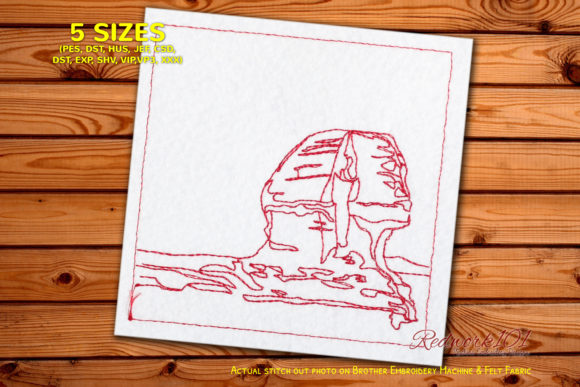
The Great Sphinx of Giza Redwork
First Impressions: Timeless, Thoughtful, and Quietly Powerful
As an embroidery designer who’s tested hundreds of motifs for personalized gift shops—from baby blankets to wedding keepsakes—I opened The Great Sphinx of Giza Redwork with genuine curiosity. What struck me first wasn’t just its iconic silhouette, but its emotional weight: calm, ancient, grounded. It doesn’t shout—it invites quiet attention. The redwork style lends warmth and approachability without sacrificing dignity, making it feel simultaneously handmade and heirloom-worthy. It’s not playful or whimsical; it’s classic with a whisper of mystery—ideal for customers seeking meaning over trend.
A Versatile Anchor for Meaningful Personalized Gifts
This design shines where intention matters most. Picture it stitched in soft red thread on a cream organic cotton baby blanket—subtle, serene, and culturally rich for a little one named Kai or Amira. Or imagine it centered on a linen pillow cover for a newlywed couple who traveled to Egypt together; the Sphinx becomes more than decoration—it’s a tactile memory. For Etsy sellers and small shop owners, The Great Sphinx of Giza Redwork offers instant storytelling: a conversation starter, a cultural touchstone, a symbol of endurance and wisdom.
It works beautifully across categories:
- Baby embroidery: Gentle scale and clean lines avoid overwhelming tiny garments—perfect for onesies, burp cloths, or milestone blankets.
- Wedding gift: Embroidered on a custom tote or hand-stitched napkin set, it signals thoughtfulness and shared values—not just aesthetics.
- Nursery decor: On a framed wall hanging or muslin crib sheet, it adds quiet sophistication without cliché animal motifs.
- Embroidered towel & kitchen linen: Crisp red thread pops against natural cotton or terry—just ensure stitch density allows for absorbency.
- Pillow covers & aprons: Its strong horizontal profile anchors well on rectangular surfaces, especially when paired with minimalist text (“Forever Curious” or “Guardian of Moments”).
Where to Use It With Care
Like any meaningful motif, The Great Sphinx of Giza Redwork deserves thoughtful placement. Avoid using it on products where fine detail could be lost or distorted:
- Stretchy baby clothes: Knits like interlock or jersey may pull stitches out of alignment—opt for stable weaves instead.
- Textured or thick fabrics: Heavy terry cloth or bouclé can swallow delicate contours; test stitch density and stabilizer support first.
- Curved surfaces (e.g., mugs, curved tote handles): This is a flat embroidery file—best reserved for planar items like towels, blankets, or flat panels.
- Dark fabric without contrast testing: Redwork traditionally relies on light fabric + red thread. On charcoal or navy, verify thread visibility—consider burgundy or burnt orange alternatives.
- Items needing frequent washing: While redwork holds up well, always use high-quality polyester thread and recommend cold gentle cycles to preserve vibrancy.
Why It Elevates Giftability—and Customer Trust
In today’s crowded handmade market, buyers don’t just purchase embroidery—they buy confidence, care, and connection. The Great Sphinx of Giza Redwork delivers that instantly. Its association with Asia (as a cross-cultural icon rooted in ancient Egyptian heritage yet widely resonant across Asian art traditions) adds depth without appropriation—especially when paired with respectful context in product descriptions. Customers recognize craftsmanship in its balanced proportions and intentional simplicity.
Photographing this design is a joy: it reads clearly even in natural light, scales well for Instagram thumbnails, and pairs effortlessly with neutral backdrops. That visual clarity boosts buyer engagement—no squinting, no confusion. And because it feels inherently *designed*, not mass-produced, it reinforces perceived value for your handmade product—even as a digital embroidery file.
Practical Embroidery Notes You’ll Want to Run Before Your First Order
Before stitching The Great Sphinx of Giza Redwork for a customer—or listing it on Etsy—run these checks:
- Test on scrap fabric: Mimic your final substrate (e.g., waffle weave towel vs. quilting cotton) to assess how thread lays and stabilizer performs.
- Verify thread color contrast: Print a mockup or view on-screen at 100% zoom—does the red pop? Does it read as warm or muddy?
- Confirm hoop size compatibility: Does the design fit comfortably within your machine’s standard hoop? If oversized, plan for re-hooping or multi-position work.
- Review stitch density: Too dense = stiff fabric; too sparse = fragile edges. Look for smooth curves and consistent fill in the lion’s mane and headdress.
- Choose stabilizer wisely: Tear-away works for stable cottons; cut-away adds durability for towels or bags; lightweight fusible helps prevent shifting on linens.
- Compare light/dark fabric mockups: A printable mockup saves time—and avoids costly re-dos.
- Inspect small details post-stitch: Check the eyes, nose, and base contour—do they hold definition? Adjust tension if needed.
- Confirm commercial licensing: If selling finished products (not just the file), ensure your license permits resale—this is essential for Etsy sellers and small shop owners.
A Design That Carries Weight—In the Best Way
The Great Sphinx of Giza Redwork isn’t just another embroidery file. It’s a quiet invitation—to pause, reflect, and personalize with purpose. Whether you’re stitching for a newborn’s first blanket, a couple’s tenth anniversary, or a boutique’s signature line of embroidered totes, this motif brings gravitas without gravity. It reminds us that the strongest personalized gifts aren’t the flashiest—they’re the ones that resonate long after the wrapping paper’s gone.