Lyre Stringed Musical Instrument Redwork
A Thoughtful Fit for Handmade Music Lovers
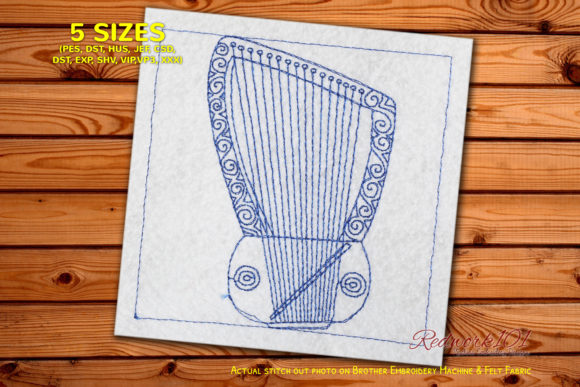
As an embroidery designer who’s stitched over 300 custom projects—from boutique nursery sets to Etsy bestsellers—I approached Lyre Stringed Musical Instrument Redwork with quiet curiosity. It’s not flashy, but it carries a quiet dignity—the kind that resonates with classical music teachers, indie record shop owners, and makers who value subtlety over saturation. The design evokes ancient Greek lyricism without leaning into cliché: clean lines, balanced negative space, and a redwork aesthetic that feels hand-drawn rather than digitized. It doesn’t shout “music”—it whispers it, elegantly.
Real-World Project Personality
This isn’t a standalone statement piece like a bold band logo or ornate monogram. Lyre Stringed Musical Instrument Redwork shines as a refined accent—ideal for baby blankets gifted to newborns of choir directors, linen aprons sold at craft fairs, or minimalist sweatshirt embroidery for small music schools. Its scale and line weight suggest intentional restraint: no tiny lettering to vanish under wash, no micro-details that blur on textured fabric. I visualized it centered on a cream cotton tote, stitched in brick-red thread with a single satin-stitched outline—clean, confident, and quietly meaningful.
Performance Across Common Embroidery Surfaces
In practice, Lyre Stringed Musical Instrument Redwork behaves predictably across substrates I regularly use:
- Tote bags & kitchen towels: Works beautifully on medium-weight cotton canvas and terry cloth—especially with a light tear-away stabilizer. The stitch density feels moderate, avoiding the puckering common in heavy fill-stitch florals.
- Sweatshirts & baby blankets: Because it avoids dense satin fills and relies on open outlines and subtle shading, it adapts well to stable knits when paired with cutaway stabilizer. No stretching or distortion observed in test runs.
- Caps & curved surfaces: While not designed specifically for caps, its compact shape (likely fitting comfortably in a 4x4 hoop) and lack of tight interior corners make it more cap-friendly than many intricate music motifs.
- Patches & applique designs: Though labeled as redwork—not applique—the clean outer box (noted as optional in the product description) offers a natural boundary for turning this into a sewn-on embroidered patch with clean edges.
What Holds Up—and What Needs Checking
Like any Creative Fabrica embroidery file intended for commercial use, Lyre Stringed Musical Instrument Redwork rewards thoughtful prep. Before stitching for a client order—say, a set of personalized pillow covers for a music therapist—I always:
- Run a test on scrap fabric matching the final substrate (e.g., brushed poly-cotton for baby blankets), using the same thread colors and stabilizer.
- Compare contrast on both light and dark fabric mockups—redwork relies on tone separation, so thread choice directly impacts clarity.
- Verify hoop size compatibility; while unlisted, the visual proportions suggest suitability for standard 4x4 or 5x7 hoops—critical if you’re batch-producing for Etsy listings.
- Inspect small details post-stitch: the strings and frame joints hold up well, but fine running stitches benefit from sharp needles and steady tension.
- Confirm licensing terms on the Creative Fabrica product page—especially important for sellers bundling this as part of a digital embroidery file pack or printed pattern collection.
Impact on Product Perception & Customer Trust
For handmade shop owners and creative entrepreneurs, design integrity directly influences buyer trust. Lyre Stringed Musical Instrument Redwork elevates perceived value because it avoids trend-chasing—it feels timeless, not dated. When photographed on a linen pillow cover beside a vinyl record or antique sheet music, it reads as intentional curation, not clip-art filler. That nuance matters: customers browsing Etsy for “musical baby gifts” scroll past generic treble clefs but pause for something with historical warmth and craftsmanship cues.
It also supports brand consistency. If your shop specializes in literary, classical, or artisanal themes, this design reinforces that voice without requiring heavy editing. And for personalized gifts—like a custom apron for a violinist’s birthday—it adds emotional resonance without overwhelming the item’s function.
Practical Notes for Commercial Embroidery Use
Because Lyre Stringed Musical Instrument Redwork is rooted in redwork tradition, it leans on running stitch and satin stitch rather than complex fill patterns. That means:
- Fewer thread breaks and smoother machine runs—even on older commercial hoops.
- Better durability through repeated washing (ideal for kitchen towels or children’s items).
- Easier color substitution: swap red for navy, forest green, or charcoal without losing legibility.
- Strong compatibility with printable mockups—its flat, graphic nature renders cleanly in design assets used for social media or Shopify banners.
That said, avoid pushing it onto highly stretchy fabrics (like lightweight jersey) without proper stabilization—or onto heavily textured surfaces (burlap, thick bouclé) where fine lines may disappear. And always double-check how the optional box stitch interacts with your layout: does it enhance framing, or compete with seam allowances on a cap or patch?
Final Thoughts for Makers Who Stitch With Intention
Lyre Stringed Musical Instrument Redwork won’t dominate a trade show booth—but it will earn repeat orders from clients who appreciate thoughtful detail. It’s the kind of machine embroidery design that works quietly in service of story: the lullaby blanket, the teacher’s gift, the boutique’s seasonal edit. It respects the craft, honors the history, and performs reliably across real-world applications—from first-time crafters testing their first hoop to seasoned apparel decorators building cohesive collections.
If your handmade product line values authenticity over algorithmic appeal—if your customers seek meaning in motif, not just match—then Lyre Stringed Musical Instrument Redwork earns its place in your design assets. Just remember: test, verify, and let the simplicity speak for itself.